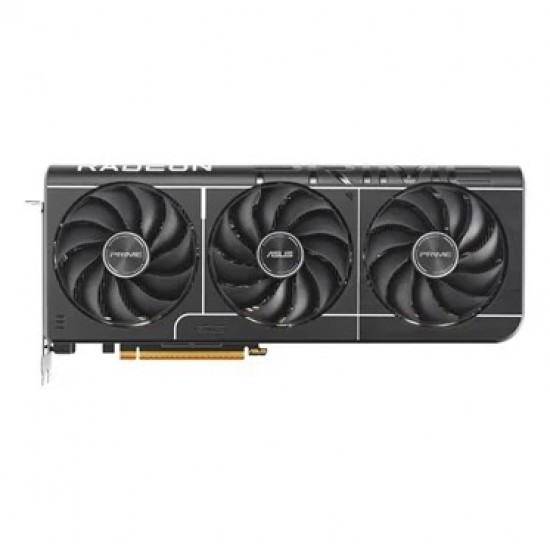
ASUS Prime -RX9070GRE-O12G AMD Radeon RX 9070 GRE 12 GB GDDR6
£0.00
Ex. VAT: £0.00
- Stock: In Stock
- Model: 90YV0PP0-M0NA00
Primed for Power
Experience Primal performance with the Prime Radeon™ RX 9070 GRE graphics card featuring a compact 2.5-slot design for expansive compatibility, enhanced by a phase-change GPU thermal pad and a triple-fan setup for supreme cooling.
Processor
CUDA
CUDA (aka Compute Unified Device Architecture) is a parallel computing platform and programming model created by NVIDIA and implemented by the graphics processing units (GPUs) that they produce. CUDA gives program developers direct access to the virtual instruction set and memory of the parallel computational elements in CUDA GPUs.
❌
Graphics processor family
The category to which the graphics processor (GPU) belongs e.g. Southern Islands family of Radeon processors (made by AMD), GeForce 600 (made by NVIDIA).
AMD
Graphics processor
Also known as a graphics processing unit (GPU), this is a specialized electronic circuit designed to rapidly manipulate and alter memory to accelerate the creation of images in a frame buffer intended for output to a display. GPUs are used in embedded systems, mobile phones, personal computers, workstations, and game consoles. Modern GPUs are very efficient at manipulating computer graphics.
Radeon RX 9070 GRE
Processor frequency
The clock rate is the fundamental rate in cycles per second (measured in hertz) at which a computer performs its most basic operations such as adding two numbers. There are more factors, like internal memory size, that influence a computer's actual response time.
2280 MHz
Processor boost clock speed
The maximum frequency the processor can automatically reach to increase performance during demanding tasks, measured in MHz.
2860 MHz
Processor frequency (OC mode)
The maximum clock speed the processor can reach when operating in overclocked mode, measured in MHz.
2880 MHz
Processor boost clock speed (OC mode)
The maximum frequency the processor can reach when operating in overclocked mode, measured in MHz.
2300 MHz
Maximum resolution
The maximum number of pixels that can be displayed in the image. It is usually quoted as width × height,: for example, "1024 × 768" means the width is 1024 pixels and the height is 768 pixels.
7680 x 4320 pixels
Parallel processing technology support
Parallel processing technology is the simultaneous use of more than one CPU or processor core to execute a program or multiple computational threads. Ideally, parallel processing makes programs run faster because there are more engines (CPUs or Cores) running it. In practice, it is often difficult to divide a program in such a way that separate CPUs or cores can execute different portions without interfering with each other. Most computers have just one CPU, but some models have several, and multi-core processor chips are becoming the norm. There are even computers with thousands of CPUs.
Not supported
Stream processors
The total number of individual cores responsible for processing data and performing calculations on the graphics processor.
3072
Maximum displays per videocard
The maximum number of independent monitors or screens that can be connected and operated simultaneously from a single unit.
4
Memory
Discrete graphics card memory
The amount of dedicated video RAM (VRAM) available on the separate graphics processing unit, measured in gigabytes (GB).
12 GB
Graphics card memory type
The type of memory used by the video card. Often a combination of dedicated memory (Video RAM or VRAM) and dynamic system memory is used. UMA stands for Unified Memory Architecture, and is a computer memory architecture that allows the graphics processing unit to share system memory. Other abreviations: RAM = Random Access Memory, SDRAM = synchronous dynamic RAM, DDR = double-data-rate.
GDDR6
Memory bus
Hardware and software that connects the main memory to the memory controller in computer systems. Originally, general-purpose buses like VMEbus and the S-100 bus were used, but to reduce latency, modern memory buses are designed to connect directly to DRAM chips, and thus are designed by chip standards bodies such as JEDEC.
192 bit
Data transfer rate
Rate at which data can be transferred. Usually expressed in units per second. May vary with network configurations.
18 Gbit/s
Ports & interfaces
Interface type
The physical or logical standard used for connecting the device to other hardware or networks (e.g. 3.5 mm or 802.11b/g/n).
PCI Express 5.0
HDMI ports quantity
The number of sockets (ports) for HDMI connections. HDMI (High-Definition Multimedia Interface) is a compact audio/video interface for transferring uncompressed video data and compressed/uncompressed digital audio data from a HDMI-compliant device ("the source device") to a compatible computer monitor, video projector, digital television, or digital audio device. HDMI is a digital replacement for existing analog video standards.
1
HDMI version
The specific release version of the High-Definition Multimedia Interface standard supported by the device (e.g. 1.3 or 2.0).
2.1b
DisplayPorts quantity
Number of DisplayPorts. A DisplayPort is a digital display interface developed by the Video Electronics Standards Association (VESA). The interface is primarily used to connect a video source to a display device such as a computer monitor, though it can also be used to carry audio, USB, and other forms of data.
3
DisplayPort version
The specific release version of the DisplayPort standard supported by the device (e.g., 1.2 or 1.4).
2.1a
Performance
OpenGL version
OpenGL (Open Graphics Library) is a specification defining a cross-language cross-platform API for writing applications that produce 3D computer graphics (and 2D computer graphics as well). The interface consists of over 250 different function calls which can be used to draw complex three-dimensional scenes from simple primitives.
4.6
Virtual Reality (VR) ready
Indicates whether the device meets the hardware and software requirements to run virtual reality applications.
✅
HDCP
High-bandwidth Digital Content Protection (HDCP) is a form of digital copy protection to prevent copying of digital audio and video content as it travels across connections.
✅
HDCP version
The version of the High-bandwidth Digital Content Protection standard supported by the device to prevent the unauthorized copying of digital audio and video content (e.g. 2.2).
2.3
Overclocked (OC) edition
Indicates whether the product has been factory-overclocked to provide higher performance than the standard reference model.
✅
Delivery Options
All delivery information is based on shipping within the United Kingdom. For orders outside the UK please email us at info@jpcomputers.co.uk with specific details to allow us to quote for delivery and lead timesShipping rates within the United Kingdom:-
• Orders under £425 exc. VAT - £2.99 plus VAT
• Orders over £425 exc. VAT - Delivery is free of charge.